Hotel Hubertus in Italy: An Alpine Hotel with a Pool and Spa Suspended Above the Slope
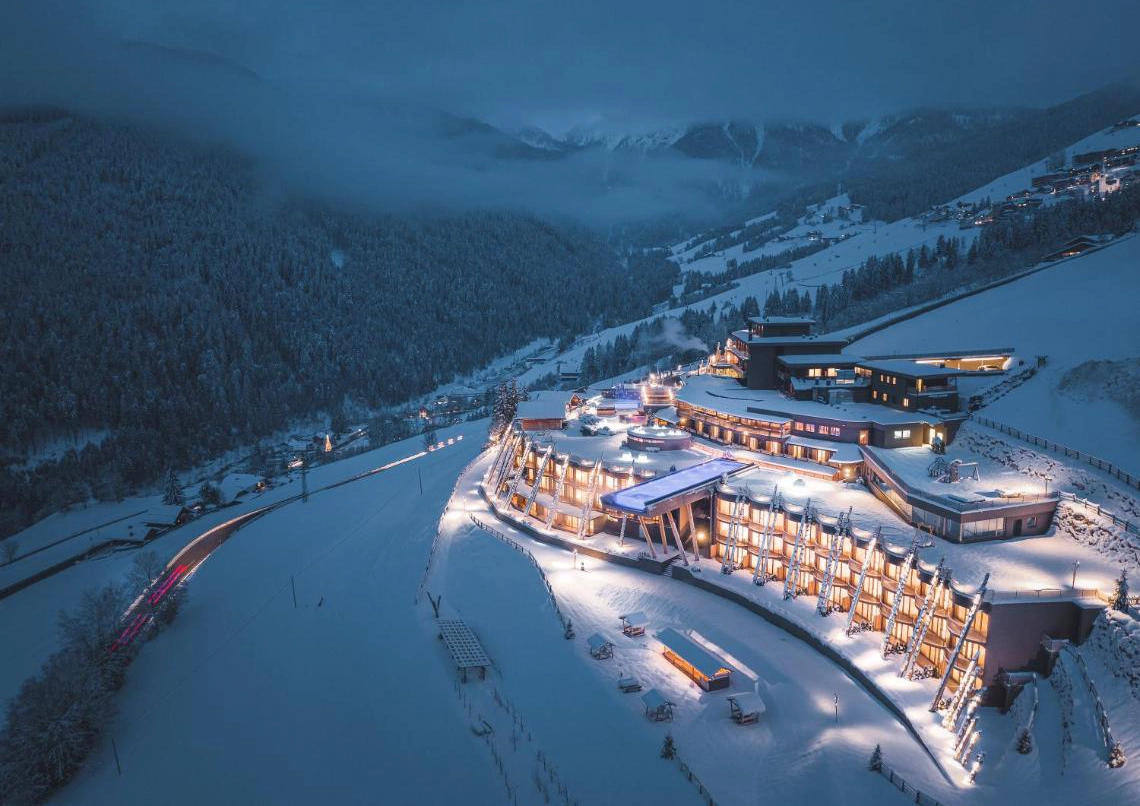
High above the Puster Valley in South Tyrol, Hotel Hubertus is one of those rare Alpine hotels where the architecture has become almost as recognisable as the surrounding mountains. The five-star hotel stands in Olang, or Valdaora in Italian, at roughly 1,350 metres above sea level near the Kronplatz ski and hiking area. Its best-known feature is a 25-metre Sky Pool projecting far beyond the hillside, while the later Heaven & Hell Sky Spa extends the same idea into a two-level wellness structure suspended above the slope. These are not isolated design features added purely for appearance: both were conceived to place the mountain landscape at the centre of the guest experience. In 2026, Hubertus remains an active, family-run Alpine hotel and has continued to evolve, with further changes to its entrance, lobby, panoramic bar and wellness facilities introduced for the summer season.
Hotel Hubertus and Its Unusual Position Above the Puster Valley
Hotel Hubertus is located in Olang in South Tyrol, northern Italy, close to the foot of Kronplatz, one of the region’s major skiing and mountain recreation areas. The elevated position is important to understanding the hotel because the surrounding terrain is not simply a backdrop. Forested slopes descend towards the valley while the mountains rise across the horizon, allowing rooms, terraces, pools and relaxation areas to face an unusually broad Alpine panorama. The building has consequently developed along the contours of the hillside rather than functioning as a conventional resort arranged around a flat central courtyard.
The present appearance of Hubertus is the result of several stages of development. A major architectural transformation completed in 2016 was designed by South Tyrolean architecture studio NOA. The project added 16 suites as well as new restaurant spaces, a kitchen, lobby and reception areas, a wine cellar, fitness facilities and panoramic relaxation spaces. The designers used native larch trunks, earth-toned materials and curved architectural forms to connect the newer parts of the hotel with the existing structure and the surrounding landscape. Instead of attempting to hide the steep location, the project used the slope as one of its defining characteristics.
Development has continued since that renovation. For summer 2026, Hubertus announced another series of changes following building work carried out between 7 April and 13 May. The hotel introduced a redesigned entrance and lobby, a new panoramic bar, a meditation room and additional sauna facilities. The newer sauna area includes a panoramic sauna used for infusion rituals, a lower-temperature biosauna and a steam bath. These additions show that the familiar images of the suspended pool represent only one stage in a property that has continued to change rather than remaining fixed around its original architectural attraction.
The 25-Metre Sky Pool Suspended Above the Hillside
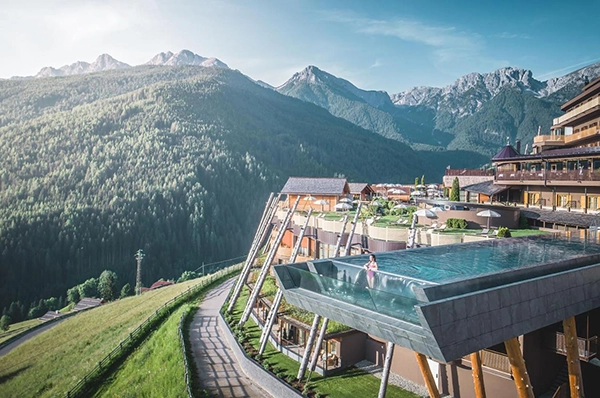
The Sky Pool is the feature most closely associated with Hotel Hubertus. Designed as part of the 2016 NOA project, it measures approximately 25 metres in length, five metres in width and 1.3 metres in depth. More than 17 metres of the structure project outwards, while the far end sits around 12 metres above the ground. Its dark exterior was designed to resemble a large rock extending from the hillside, with the visual boundaries between the water and the distant landscape deliberately reduced. From many viewpoints, most of the structure supporting the pool is difficult to see, strengthening the impression that its outer section is floating over the valley.
Two transparent elements make the construction especially distinctive. The end of the pool has a glazed front, allowing the water and mountain horizon to appear almost continuous when viewed from inside. There is also a glass section in the floor near the outer part of the pool. Swimmers can therefore look through the water towards the ground below rather than seeing only a conventional solid basin. The effect is dramatic, but the underlying idea is relatively straightforward: the pool was designed to preserve the view instead of enclosing swimmers within high walls and conventional pool edges.
The pool is not a seasonal architectural display. Hotel Hubertus operates the Sky Pool throughout the year and lists its water temperature at approximately 33°C. This makes it usable during both summer and winter, when the surrounding setting changes from green Alpine meadows to snow-covered slopes. Access to the hotel’s wellness facilities is reserved for staying guests; Hubertus states that it does not operate a day spa. The Sky Pool therefore functions as part of the hotel’s wider wellness facilities rather than as a separate attraction that outside visitors can normally book for a few hours.
Heaven & Hell Sky Spa: Wellness Turned Upside Down
The Sky Pool was later joined by an even more unusual structure known as Heaven & Hell. NOA returned to Hubertus to design this wellness extension, taking inspiration from the reflection of the landscape in the earlier pool. The resulting structure projects from the hotel on a freestanding steel framework and appears to hover beyond the edge of the slope. Instead of arranging every spa facility on one conventional floor, the architects divided the experience vertically, producing an upper and a lower level with deliberately contrasting functions.
The upper part represents the ‘Heaven’ side of the concept. Here, the emphasis is on open views, water and quiet relaxation. Guests have access to whirlpools and a relaxation room connected to the main spa by a walkway. Large floor-to-ceiling windows maintain views across Val Pusteria, continuing the same relationship between architecture and landscape established by the Sky Pool. The structure is intentionally open towards the mountains, so a guest using the wellness facilities remains visually connected to the valley instead of entering a completely enclosed spa interior.
The lower section provides the contrasting ‘Hell’ element. It contains two hot saunas, another whirlpool and facilities for cooling down, including a cold rain shower. Some areas are designed as nude wellness zones, reflecting sauna traditions common in South Tyrol and neighbouring Alpine regions, so guests should check the rules for individual facilities rather than assuming that swimwear is used throughout the entire spa. The name may sound theatrical, but in practical terms Heaven & Hell is a compact arrangement of hot, cold, water and relaxation spaces built around an unusually exposed location above the hillside.
Six Pools, Saunas and Quiet Areas Beyond the Famous Structures
Although the Sky Pool receives most of the attention, the hotel’s water facilities are considerably broader. As of 2026, Hubertus describes a wellness area with six heated indoor and outdoor pools. Alongside the Sky Pool are an indoor pool at around 31°C, an outdoor saltwater flotation pool at approximately 33°C, outdoor whirlpools heated to roughly 37°C and an outdoor cold-water pool. Heaven & Hell adds three whirlpools of its own, including seated, reclining and nude options, generally maintained at about 36°C. This range means the wellness area is designed for more than simply swimming laps in the suspended pool.
Sauna facilities have also expanded. The hotel’s current wellness offer includes seven saunas, with the 2026 additions adding different temperature and humidity options. Among the newer spaces are a panoramic sauna at approximately 82°C, a biosauna at around 55°C and a steam bath at approximately 45°C. Heaven & Hell contributes its own sauna facilities as well. The variation is useful because guests do not have to choose between only a very hot traditional sauna and a pool; there are gentler forms of heat and steam for visitors who prefer shorter or less intense sessions.
Quieter spaces are distributed through the wellness area for guests who would rather rest between swimming and sauna sessions. These include indoor relaxation rooms, a reading area, the Heaven & Hell relaxation room and the Pavilion of Peace in the hotel grounds. The visual connection with the landscape remains consistent in many of these spaces, particularly where large windows face the mountains. In practical terms, this makes Hubertus less dependent on good outdoor weather: on a cloudy winter afternoon or a rainy summer day, much of the scenery can still be appreciated from sheltered wellness and relaxation areas.
Staying at Hotel Hubertus Beyond the Pool and Spa
The architecture can easily dominate photographs of Hubertus, but the hotel operates as a full five-star Alpine property rather than a destination built around a single pool. Accommodation occupies both established and newer sections of the complex, with many rooms and suites orientated towards the surrounding mountains. The 2016 extension introduced rooms with broad glazed fronts and east-facing balconies, using timber details and restrained natural colours to continue the exterior design indoors. The result is contemporary rather than traditionally rustic, although materials such as wood and the repeated references to Alpine forms prevent the interiors from feeling disconnected from their South Tyrolean setting.
Food is another substantial part of the stay. Hubertus currently uses a three-quarter-board arrangement that includes a breakfast buffet, an afternoon food service and a five- to six-course evening menu. The hotel states that breakfast incorporates products from local farmers, while the afternoon selection can include a warm dish, soup, antipasti, salads, desserts and fruit. Dinner combines South Tyrolean, Italian and international influences, with vegetarian dishes also offered. This structure is particularly practical for a mountain hotel because guests spending the morning hiking, skiing or using the wellness area can return without having to organise every meal separately.
The location also allows Hubertus to function differently according to the season. Kronplatz is closely associated with winter skiing, but the surrounding area is also used for walking, hiking and other mountain activities during the warmer months. The hotel organises guided outdoor activities and, following its 2026 updates, also lists a partnership with Golf Club Pustertal among its services. Staying here therefore makes most sense for travellers who want to combine time inside the hotel with the surrounding landscape rather than treating the property solely as an architectural photo stop.
What Guests Should Know About Hotel Hubertus in 2026
Several details are worth checking before arranging a stay. The wellness area is reserved for hotel guests, and Hubertus does not currently advertise a day-spa option, so visiting the Sky Pool or Heaven & Hell independently of an overnight stay is not normally possible. Individual wellness areas also operate at different times during the day. The hotel currently lists the indoor pool and Sky Pool from early morning until early evening, while some outdoor pools, whirlpools and Heaven & Hell open later. Opening times can change with operational or seasonal requirements, so they are best confirmed for the dates of a particular stay.
Visitors using the spa should also pay attention to the distinction between swimwear areas and nude sauna areas. The 2026 panoramic sauna, biosauna and steam bath are identified by Hubertus as nude areas, and parts of Heaven & Hell follow similar wellness conventions. This is common in this part of Europe but may be unfamiliar to international guests. Pool temperatures likewise vary considerably, from the heated Sky Pool and warm whirlpools to the much cooler outdoor pool, allowing guests to select facilities according to comfort rather than assuming that every water area has the same purpose.
What makes Hotel Hubertus unusual is ultimately not simply that a swimming pool and spa project beyond a mountain slope. The stronger feature is the way successive renovations have repeatedly used the site’s height, terrain and views as part of the building itself. The Sky Pool made that idea immediately visible in 2016, while Heaven & Hell developed it vertically through suspended wellness spaces, and the 2026 renovation added further facilities without removing the hotel’s established architectural character. For travellers interested in contemporary Alpine architecture as well as mountain scenery and wellness, Hubertus is therefore a particularly distinctive example of how a long-established South Tyrolean hotel has been reshaped around its location rather than separated from it.