Null Stern Hotel (Switzerland): the “Zero-Star” Open-Air Room Under the Sky
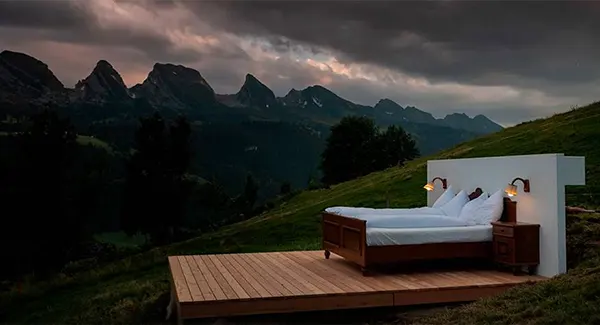
Null Stern Hotel is one of Switzerland’s most unusual hospitality concepts: instead of a building, the “room” can be a single bed placed outdoors, framed by Alpine scenery and designed as an art project as much as an overnight stay. The idea is minimal on purpose, but the experience is still curated — guests pay for the location, host service, and the concept itself, which challenges the conventional idea of what “luxury” should mean.
What the stay actually is (and what you get for the price)
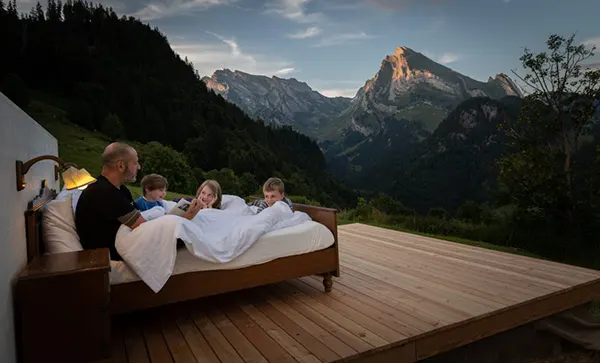
In the open-air “suite” format, Null Stern offers a proper bed with hotel-grade linen placed outside in a carefully selected landscape. There are no walls, no roof, and no private indoor room — the environment becomes the room. This is why the project is often described as a mix of accommodation and art installation rather than a traditional hotel.
Even though the physical set-up is simple, service is part of what guests pay for. Depending on the edition and location, the experience typically includes a host (often referred to as a “butler”) who welcomes guests, helps with the practical details, and provides breakfast in the morning. In many versions, breakfast is delivered as a basket or served directly near the bed.
Pricing is not symbolic or “cheap.” Switzerland is an expensive destination, and Null Stern positions itself as a premium concept stay. In recent years, published examples have often placed the cost around CHF 325–350 per night, with the final amount depending on the season, availability, and the specific edition running that year.
How booking works and what to check before you confirm
Null Stern is best understood as a seasonal concept with changing locations, not as a single hotel address. The “suite” is set up in a particular place for a defined period, and that makes availability limited. Because only a small number of guests can stay per night, it is normal to see dates sell out well in advance during peak travel months.
Before booking, it is worth checking practical details that matter in real life: where the nearest facilities are, what time check-in happens, and how the host service is structured. In many editions, the bathroom is not at the bed itself and may be located in a nearby building or partner property within walking distance. That detail is important, especially at night or during poor weather.
It is also essential to understand the “bad weather plan.” Outdoor sleeping in Switzerland can be spectacular, but it can also turn uncomfortable quickly if conditions change. Some editions have provided alternative arrangements with nearby conventional accommodation when weather becomes unsuitable — and this can be the difference between a memorable experience and a stressful one.
Safety, privacy and seasonality: the realities of sleeping outdoors in Switzerland
The biggest questions people ask are usually about safety and privacy. Null Stern relies on careful site selection rather than physical barriers, and the locations are typically chosen to avoid heavy foot traffic. Guests are not simply left alone in the wilderness: the stay is managed, with hosts guiding visitors and keeping the experience controlled and structured.
Seasonality is non-negotiable. Switzerland’s climate can change fast, and in Alpine areas even summer nights can feel cold. The open-air suites generally operate only during suitable periods of the year, commonly from spring to early autumn, because it is not realistic or comfortable to run the concept throughout the full Swiss winter.
Privacy is different from what people expect in a standard hotel room. You do not get four walls and a locked door, so comfort depends on how remote the site is and how you personally feel about sleeping in an open environment. Many guests love this vulnerability because it feels rare and raw, but others may find it too exposed.
Who it suits (and who usually regrets it)
The concept tends to suit travellers who value calm and simplicity: couples looking for a distinctive romantic night, people seeking a slow and reflective experience, and visitors who enjoy waking up to nature rather than to a corridor or a reception desk. For this type of guest, the lack of walls feels like the point, not a drawback.
It can also appeal to people who like idea-driven travel. Null Stern was built to provoke thought about the modern hospitality industry and about what society labels as “luxury.” Some editions have even placed the bed in deliberately non-idyllic surroundings to make the guest confront how much of travel is based on image rather than meaning.
However, it often disappoints travellers who need predictable comfort. If you are a light sleeper, if you rely on private indoor facilities, or if you become anxious without clear boundaries, then the price can feel difficult to justify. Null Stern is not trying to please everyone — it is built around a very specific type of traveller mindset.
How the project evolved: from bunker rooms to outdoor suites
Null Stern did not start as an outdoor bed. Earlier versions of the project gained attention through the idea of transforming unusual spaces, including a well-known “zero-star” bunker concept that framed the stay as an artistic statement about simplicity and consumer culture. That origin story still shapes how the project is discussed today.
From the mid-2010s onward, the concept became widely recognised for its open-air “suite” format. This shift made the experience more visual and more directly connected to landscape: the location itself became the central design element. The idea was not only to provide a place to sleep, but also to create a setting that feels like a curated piece of living art.
Over time, the project has experimented with contrast. Not every edition aims for postcard perfection. Some of the most talked-about installations have used locations that feel ordinary or even uncomfortable — such as areas near busy roads — to reinforce the project’s message: the “room” is a lens through which you experience modern life, not merely an escape from it.
What to expect in 2026: the most accurate way to think about Null Stern
As of 2026, Null Stern is best described as a seasonal, location-based concept rather than a standard hotel product. The details change depending on where and when the edition is running, so travellers should always treat older descriptions as historical examples rather than guaranteed features.
What has remained consistent is the basic model: a real bed outdoors, host support, and a premium price that reflects the curated nature of the experience rather than the amount of infrastructure. If you research the stay for 2026, it is sensible to verify the current location, the facilities arrangement, and what is included in the specific edition offered at that time.
The key is expectation management. Null Stern is not “camping with a fancy mattress,” and it is not a conventional boutique hotel either. It is a deliberately stripped-down experience, designed to make the guest feel the landscape, the exposure, and the idea behind the project — and that works best when you go in specifically for that reason.